Jairus's Daughter: The Bible Story of the Girl Jesus Raised
Who Jairus was, why Jesus stopped for the bleeding woman on the way, and what 'Talitha koum' means — Mark 5 explained. Listen to the story on HearBibleStories.
Posted by
 HearBibleStories Editorial Team
Related reading
Daniel in the Lions' Den: What Really Happened in Daniel 6
The full story of Daniel in the lions' den — the political trap, the sealed den, the angel, and what Daniel 6 is really about. Listen along.
The Good Samaritan: The Meaning of Jesus' Most Famous Parable
The parable of the Good Samaritan, explained — the lawyer's question, why a Samaritan hero was shocking, and the question Jesus flips. Listen along.
The Real Story of the Prodigal Son — What Most People Miss
Everyone remembers the father running. But the older brother is the real twist. Discover what Jesus was really saying — then listen on HearBibleStories.
The raising of Jairus's daughter is told in Matthew, Mark, and Luke, but Mark tells it best — as two stories folded into one, a technique scholars call a Markan "sandwich." Understanding why he interleaves them is the key to the whole passage.
Who Was Jairus?
Jairus is "one of the rulers of the synagogue" (Mark 5:22) in a lakeside town, probably Capernaum. That title matters. A synagogue ruler was a respected community leader responsible for worship and order — exactly the kind of establishment figure who, elsewhere in the Gospels, keeps a wary distance from Jesus. And yet Jairus "fell at his feet and implored him earnestly" (Mark 5:22–23): "My little daughter is at the point of death. Come and lay your hands on her, so that she may be made well and live."
His daughter is twelve years old (Mark 5:42) — on the edge of adulthood in that culture, old enough to be betrothed. For a man of his standing to throw himself into the dust in a public street is a measure of how far past dignity a dying child pushes a parent.
The Interruption
Jesus goes with him, followed by a crushing crowd. Then the story stops.
A woman who has had a flow of blood for twelve years — the same number of years the girl has been alive — comes up behind Jesus and touches his cloak, thinking, "If I touch even his garments, I will be made well" (Mark 5:28). Under the purity laws of Leviticus 15, her condition made her ritually unclean and, by extension, everyone and everything she touched. She has spent everything on doctors and is worse, not better (Mark 5:26). She approaches from behind because she is not supposed to be in the crowd at all.
The bleeding stops instantly. Jesus stops too: "Who touched my garments?" The disciples think it is an absurd question in that throng. But Jesus keeps looking, and the woman comes forward "in fear and trembling" and tells him "the whole truth" (Mark 5:33). He does not rebuke her. He calls her "daughter" — the only time in the Gospels he uses that word for anyone — and says, "Your faith has made you well; go in peace" (Mark 5:34).
"While He Was Still Speaking"
The delay has a cost. "While he was still speaking, there came from the ruler's house some who said, 'Your daughter is dead. Why trouble the Teacher any further?'" (Mark 5:35).
This is why Mark braids the two stories together. Jairus has just watched Jesus take time he did not have — to heal someone who, by every social measure, mattered less than a synagogue ruler's daughter. And now his own child is gone. Jesus turns to him immediately: "Do not fear, only believe" (Mark 5:36).
Talitha Koum
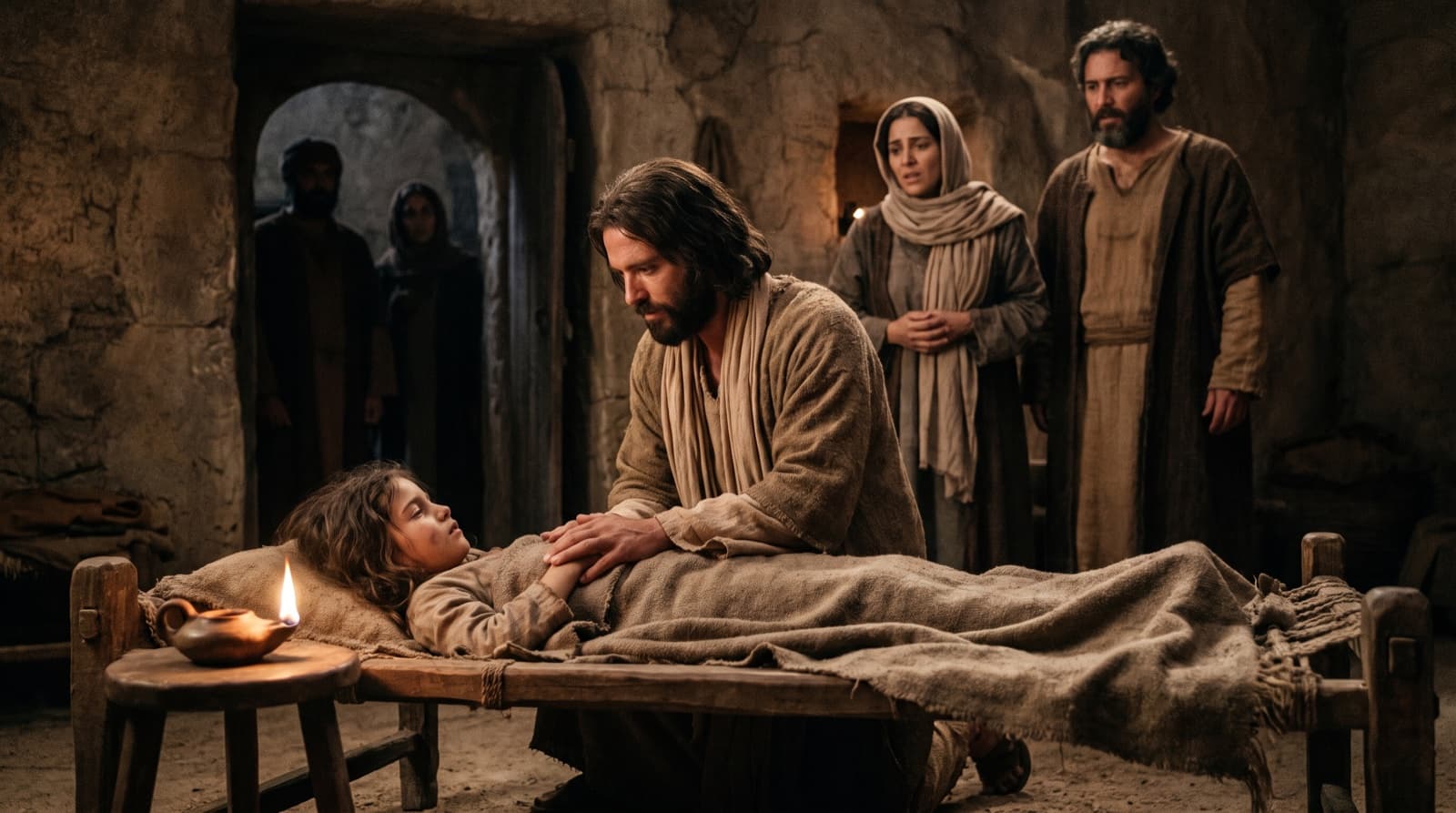
At the house, the professional mourners have already arrived, weeping and wailing. Jesus says the child is "not dead but sleeping," and they laugh at him (Mark 5:39–40). He puts them all outside, takes the parents and three disciples into the room, takes the girl by the hand — another touch that should transmit uncleanness and instead transmits life — and says, "Talitha koum."
Mark preserves the Aramaic and translates it: "Little girl, I say to you, arise" (Mark 5:41). It is gentle, almost domestic — the phrase a parent uses to wake a child for the day. "And immediately the girl got up and began walking" (Mark 5:42).
Then a strikingly ordinary instruction: he tells them to give her something to eat. The same Jesus who commands the storm one chapter earlier also notices that a recovering twelve-year-old is hungry.
What the Story Is Doing
Both people Jesus helps here are, in the eyes of the law, sources of contamination — a woman with a chronic discharge and a corpse. In every other setting, contact flows one direction: uncleanness spreads. Here it reverses. Jesus touches, and is touched, and wholeness moves outward instead.
And the two stories interpret each other. The woman had no name, no status, and twelve years of failure behind her; the girl had a powerful father and everything ahead of her. Jesus gives both the same word — daughter — and the same outcome. Faith, in Mark, is not a matter of standing. It is a matter of coming to him anyway.
Heard in one sitting, the pacing of Mark 5 does the work — the urgency, the maddening pause, the news from the house, the quiet room. You can listen to the story on HearBibleStories, and hear it alongside Daniel's test of faith under pressure and the parable of the Good Samaritan.
Listen to these stories
Jairus's Daughter
He told a dead girl to get up — and she did.
Mark 5:21-43
Lazarus Raised
Jesus wept. Then he shouted at a tomb — and the dead man walked out.
John 11:1-44
Calming the Storm
The disciples were terrified of the storm. Then they were terrified of the man who stopped it.
Mark 4:35-41
Hear the Bible come to life
Listen to hundreds of Bible stories with HD narration on the HearBibleStories app.


Or browse the full story catalogue on the web.
Related reading
Daniel in the Lions' Den: What Really Happened in Daniel 6
The full story of Daniel in the lions' den — the political trap, the sealed den, the angel, and what Daniel 6 is really about. Listen along.
The Good Samaritan: The Meaning of Jesus' Most Famous Parable
The parable of the Good Samaritan, explained — the lawyer's question, why a Samaritan hero was shocking, and the question Jesus flips. Listen along.
The Real Story of the Prodigal Son — What Most People Miss
Everyone remembers the father running. But the older brother is the real twist. Discover what Jesus was really saying — then listen on HearBibleStories.
The Prodigal Son — The Older Brother Is the Real Story
Everyone remembers the son who left. Almost nobody talks about the son who stayed — and his reaction is the real point of the parable.