The Good Samaritan: The Meaning of Jesus' Most Famous Parable
The parable of the Good Samaritan, explained — the lawyer's question, why a Samaritan hero was shocking, and the question Jesus flips. Listen along.
Posted by
 HearBibleStories Editorial Team
Related reading
What Are the Ten Commandments? The Full List and What Each One Means
The Ten Commandments, listed and explained: the two tablets, Exodus 20 vs Deuteronomy 5, the numbering traditions, and Jesus' summary. Listen along.
Daniel in the Lions' Den: What Really Happened in Daniel 6
The full story of Daniel in the lions' den — the political trap, the sealed den, the angel, and what Daniel 6 is really about. Listen along.
Samson and Delilah: The Full Story of Strength, Betrayal, and One Last Prayer
The full story of Samson and Delilah — the Nazirite vow, the riddle and the foxes, the betrayal for silver, and the temple of Dagon. Listen along.
Luke introduces the parable with an argument, not a sermon. "On one occasion an expert in the law stood up to test Jesus. 'Teacher,' he asked, 'what must I do to inherit eternal life?'" (Luke 10:25). Jesus turns it back on him: what does the law say? The man answers well, quoting two passages — love God with everything (Deuteronomy 6:5) and love your neighbor as yourself (Leviticus 19:18). Jesus tells him he is right: "Do this and you will live" (10:28).
It could have ended there. Instead Luke adds a detail that gives the parable its edge: the man, "wanting to justify himself," asks a follow-up question — "And who is my neighbor?" (Luke 10:29). What comes next is Jesus' answer to a question asked in self-defense.
A Question Designed to Draw a Line
"Who is my neighbor?" sounds sincere, but in context it is a request for a boundary. Leviticus 19:18 says to love your neighbor; the surrounding verses seem to have fellow Israelites in view. A first-century teacher could reasonably ask where the obligation ended — fellow Jews? fellow observant Jews? The question treats love as a limited resource that needs a fence around it. Jesus' story quietly removes the fence.
The Road Everyone Knew Was Dangerous
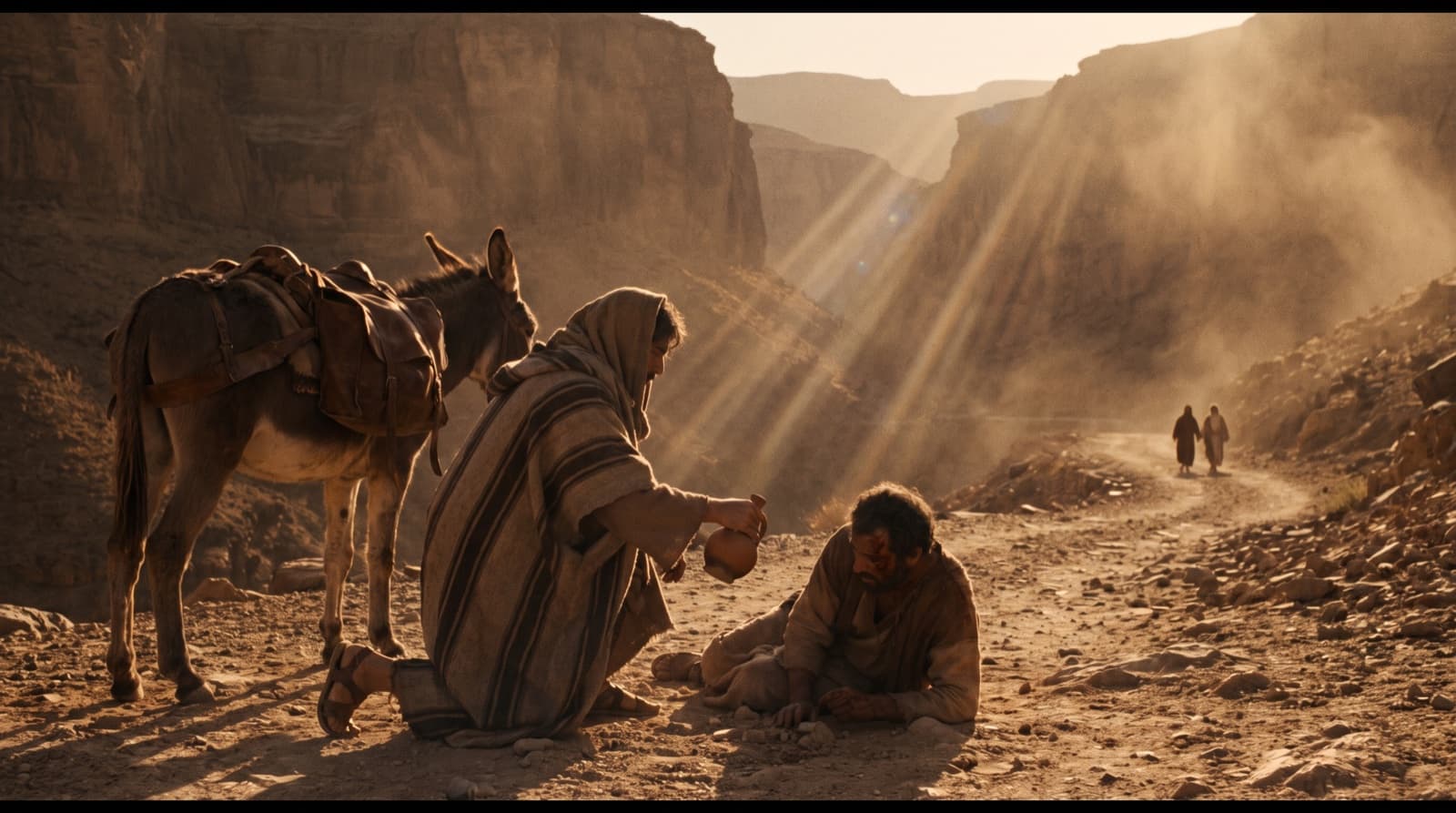
"A man was going down from Jerusalem to Jericho, when he was attacked by robbers" (Luke 10:30). That road drops roughly 3,300 feet over about seventeen miles of bare, rocky wilderness with endless spots for an ambush. It was notorious enough that one stretch was later nicknamed the "Ascent of Blood," and travelers normally moved in groups for safety. Jesus' listeners did not need the danger spelled out. The victim is stripped, beaten, and left "half dead" — unconscious and without clothing, which means no passerby could identify him by dress or accent as a member of any particular group. He is simply a body in the road.
The Two Men Who Passed By
A priest comes down the road, sees the man, and "passed by on the other side" (Luke 10:31). A Levite does the same (10:32). Sermons often explain the choice with purity law — contact with a corpse would defile a priest (Numbers 19:11-13). It is possible, but Jesus gives no reason at all. That silence may be the point: whatever the justification was, it satisfied two religious professionals and still left a man to die. The law behind the Ten Commandments was never meant to be a set of technicalities you could keep while stepping around a dying neighbor.
Why "Good Samaritan" Was Almost a Contradiction
"But a Samaritan, as he traveled, came where the man was; and when he saw him, he took pity on him" (Luke 10:33). To the first audience, that sentence landed with a jolt. Jews and Samaritans had been hostile for centuries — a feud over ancestry, over the right place to worship, and over rival versions of the Torah. John 4:9 states plainly that Jews "do not associate with Samaritans." Only one chapter earlier in Luke, a Samaritan village snubbed Jesus and the disciples asked whether they should call down fire on it (Luke 9:53-54).
So Jesus makes his hero a member of the group his listeners most despised — and the Samaritan's help is not the bare minimum. He bandages the wounds, cleans them with oil and wine, puts the man on his own animal, walks him to an inn, pays the innkeeper two days' wages, and promises to cover any extra cost on his way back (Luke 10:34-35). It is personal, extended, and expensive.
The Question Jesus Refused, and the One He Asked Instead
Jesus ends with a question that changes the terms: "Which of these three do you think was a neighbor to the man who fell into the hands of robbers?" (Luke 10:36). The lawyer had asked which people qualify as his neighbor — who belongs on the list. Jesus asks which of the three acted as a neighbor. The category stops being a test you apply to other people and becomes something you either are or are not.
The lawyer cannot bring himself to say the word "Samaritan." He answers, "The one who had mercy on him." Jesus says, "Go and do likewise" (Luke 10:37).
What the Parable Is Not Saying
The story is so familiar that it has picked up meanings it does not carry. It is not mainly a lesson about roadside first aid, and the "good Samaritan" laws that protect volunteer rescuers borrow the name more than the point. It is also not a blanket attack on the priesthood; the priest and the Levite stand in for anyone whose reasons for not stopping seem good enough at the time. And it is not a claim that Samaritans were generally better people than Jews — the shock of the story depends on the audience assuming the opposite. What the parable does is take the word "neighbor," which the lawyer wanted to use as a filter, and turn it into a description of a life.
Set beside the father running to meet a wasteful son, or Jesus' habit of eating with tax collectors, the Good Samaritan fits a pattern that runs through Luke's whole Gospel: mercy that crosses the lines other people treat as permanent. It is the same costly loyalty found in Daniel's refusal to stop praying after it was outlawed. The parable is short enough to read in a minute and deep enough to sit with for years. You can listen to the story on HearBibleStories and hear it in the setting of the question that provoked it.
Listen to these stories
The Good Samaritan
The hero of the story was the last person they'd want as a neighbor.
Luke 10:25-37
The Prodigal Son
The father ran. In that culture, dignified men never ran.
Luke 15:11-32
Mary and Martha
One sister served. One sister sat. Jesus said the one sitting chose better.
Luke 10:38-42
Hear the Bible come to life
Listen to hundreds of Bible stories with HD narration on the HearBibleStories app.


Or browse the full story catalogue on the web.
Related reading
What Are the Ten Commandments? The Full List and What Each One Means
The Ten Commandments, listed and explained: the two tablets, Exodus 20 vs Deuteronomy 5, the numbering traditions, and Jesus' summary. Listen along.
Daniel in the Lions' Den: What Really Happened in Daniel 6
The full story of Daniel in the lions' den — the political trap, the sealed den, the angel, and what Daniel 6 is really about. Listen along.
Samson and Delilah: The Full Story of Strength, Betrayal, and One Last Prayer
The full story of Samson and Delilah — the Nazirite vow, the riddle and the foxes, the betrayal for silver, and the temple of Dagon. Listen along.
The Real Story of the Prodigal Son — What Most People Miss
Everyone remembers the father running. But the older brother is the real twist. Discover what Jesus was really saying — then listen on HearBibleStories.