Samson and Delilah: The Full Story of Strength, Betrayal, and One Last Prayer
The full story of Samson and Delilah — the Nazirite vow, the riddle and the foxes, the betrayal for silver, and the temple of Dagon. Listen along.
Posted by
 HearBibleStories Editorial Team
Related reading
What Are the Ten Commandments? The Full List and What Each One Means
The Ten Commandments, listed and explained: the two tablets, Exodus 20 vs Deuteronomy 5, the numbering traditions, and Jesus' summary. Listen along.
Daniel in the Lions' Den: What Really Happened in Daniel 6
The full story of Daniel in the lions' den — the political trap, the sealed den, the angel, and what Daniel 6 is really about. Listen along.
The Good Samaritan: The Meaning of Jesus' Most Famous Parable
The parable of the Good Samaritan, explained — the lawyer's question, why a Samaritan hero was shocking, and the question Jesus flips. Listen along.
Samson gets four chapters — Judges 13 through 16 — more than any other judge in the book. He also has the strangest career of any of them. He never raises an army, never gives a speech, never calls the nation to repentance, and never seems to understand the role he was born for. He is the last major judge before Israel demands a king, and his life reads like a case study in wasted calling.
A Son Promised Before He Was Born
Judges 13 opens with Israel "in the hands of the Philistines forty years" (13:1) — and, unusually for the book, with no mention of Israel crying out for help. The angel of the LORD appears to the wife of a man named Manoah, who has had no children, and announces a son who "will take the lead in delivering Israel from the hands of the Philistines" (13:5). The boy is to be a Nazirite "from the womb" — a lifelong form of a vow people normally took for a short, fixed period (Numbers 6:1-8).
The Vow That Was Supposed to Define Him
The Nazirite vow had three visible parts: no wine or grape products, no contact with a dead body, and no cutting of the hair (Numbers 6:3-6). Samson breaks all three. He holds a "feast" at Timnah, using a word that implies drinking (Judges 14:10). He scrapes honey out of a lion's carcass and eats it, then says nothing to his parents about where it came from (14:8-9). Only the uncut hair survives — and nearly everyone in the story treats it as if the hair itself were the magic.
The text is more careful than that. Samson's strength is tied to the vow as a whole and to "the Spirit of the LORD" that comes powerfully upon him at key moments (Judges 13:25; 14:6, 19; 15:14). The hair is just the last visible piece of a consecration he had otherwise thrown away. When it finally goes, Judges 16:20 delivers one of the saddest sentences in Scripture: "But he did not know that the LORD had left him." That gap — between a huge gift and a collapsed discipline — is the whole tragedy of Samson. It is worth reading next to the story of Daniel, a man with far less spectacular power who kept his daily practices intact for seventy years under three pagan empires.
Riddles, Foxes, and a Cycle of Revenge
Samson's adult life is a chain of personal grievances that God works through anyway. He wants to marry a Philistine woman because "she is right in my eyes" (Judges 14:3) — a phrase that echoes the book's refrain that in those days "everyone did what was right in his own eyes" (Judges 21:25). At the wedding feast he poses a riddle; his thirty companions threaten his bride to get the answer; when he loses the bet he kills thirty men in Ashkelon to pay it (14:19).
The feud spirals. Samson ties torches to the tails of 300 foxes and burns the Philistines' standing grain (Judges 15:4-5). They retaliate by burning his wife and her father to death. He strikes them "hip and thigh" (15:8), is handed over to them by his own countrymen from Judah, snaps the ropes, and kills a thousand men with the jawbone of a donkey (15:15). None of this looks like the deliverance the angel described — and yet Judges 15:20 notes almost in passing that "Samson led Israel for twenty years in the days of the Philistines."
Delilah and the Weight of Silver
Judges 16 brings in Delilah, from the Valley of Sorek. The text never calls her Samson's wife and never says he was loved in return — only that "he fell in love with a woman" (16:4), while the five Philistine rulers each offer her 1,100 shekels of silver to discover "the secret of his great strength" (16:5). That is a staggering sum; combined, it is a fortune large enough to explain her persistence.
Delilah asks him outright, and three times he lies — fresh bowstrings, new ropes, weaving his hair into a loom. Each time she immediately springs the trap ("The Philistines are upon you, Samson!"), and each time he wakes, escapes, and says nothing about the fact that she has now tried to hand him over three times. Judges 16:16 says she "prodded him day after day until he was sick to death of it." Finally "he told her everything" (16:17). He gives up the last sign of his vow not under torture but out of sheer exhaustion, to someone he had already watched betray him.
Blind in Gaza, and the Last Prayer
The Philistines seize him, gouge out his eyes, and set him grinding grain in the Gaza prison (Judges 16:21). Then the narrator drops in a quiet line: "But the hair on his head began to grow again after it had been shaved" (16:22) — not because hair is magic, but as a hint that the door had not closed.
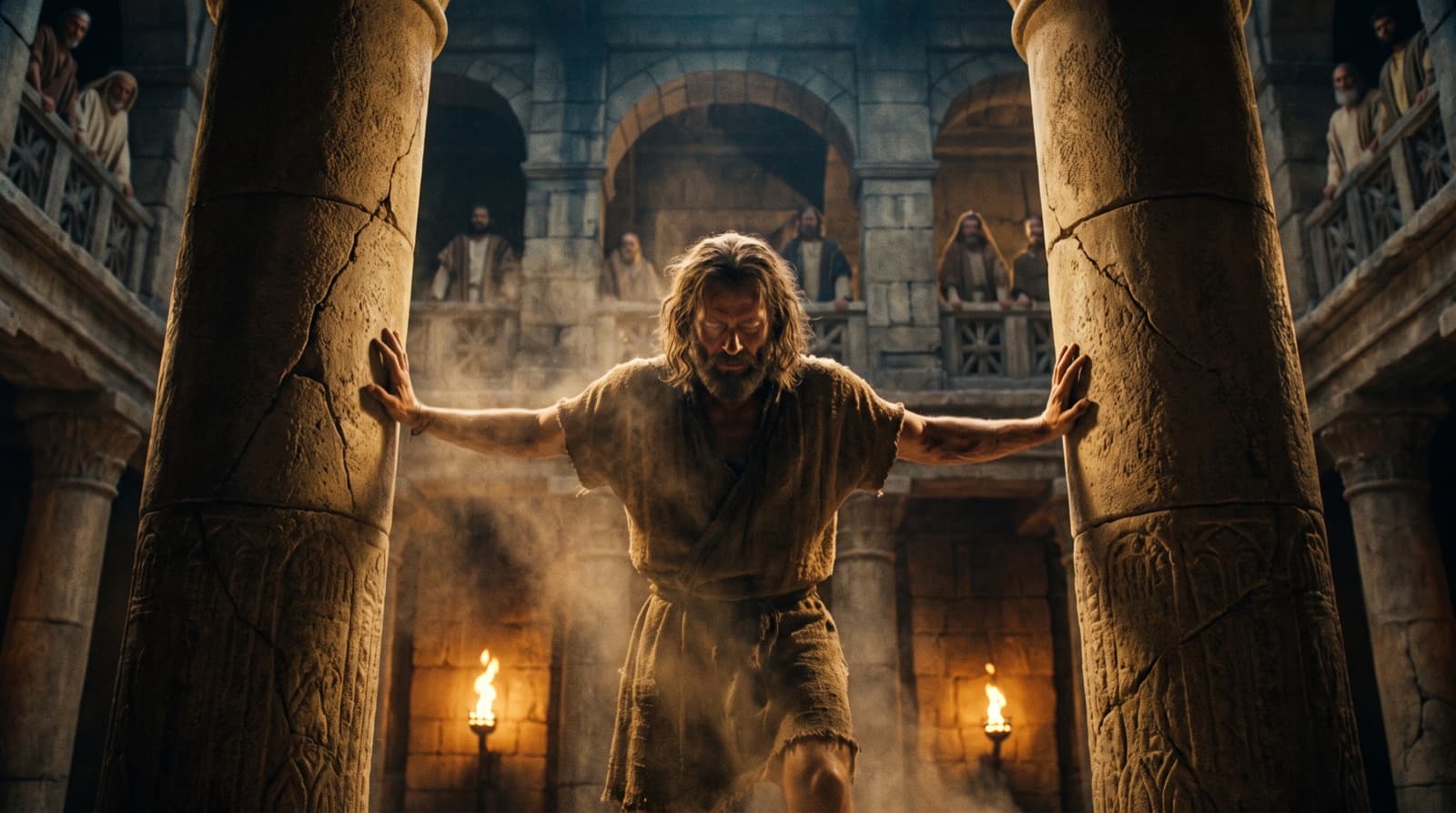
At a festival for their god Dagon, the rulers bring Samson out to entertain the crowd, crediting their victory to their god: "Our god has delivered Samson, our enemy, into our hands" (Judges 16:23-24). The irony runs deep — Dagon was associated with grain, and Samson's feud had escalated over burned Philistine grain fields. Positioned between the temple's two central pillars, Samson prays for the first time in the story with any humility: "Sovereign LORD, remember me. Please strengthen me just once more" (Judges 16:28). He pushes; the temple falls; and "he killed many more when he died than while he lived" (16:30). Hebrews 11:32 lists him among the heroes of faith — not for how he lived, but for that final act of trust.
Samson's story sits at the bottom of the judges era, right before Israel says "give us a king like the other nations." It is a book about a people with no shared center — the absence that the Ten Commandments were meant to fill, and the same self-giving love that the parable of the Good Samaritan later holds up as the entire point of the law. Samson's life moves fast, and hearing it read in one sitting brings out both the dark humor and the heartbreak. You can listen to the story on HearBibleStories and follow him from the vineyards of Timnah to the temple in Gaza.
Listen to these stories
Hear the Bible come to life
Listen to hundreds of Bible stories with HD narration on the HearBibleStories app.


Or browse the full story catalogue on the web.
Related reading
What Are the Ten Commandments? The Full List and What Each One Means
The Ten Commandments, listed and explained: the two tablets, Exodus 20 vs Deuteronomy 5, the numbering traditions, and Jesus' summary. Listen along.
Daniel in the Lions' Den: What Really Happened in Daniel 6
The full story of Daniel in the lions' den — the political trap, the sealed den, the angel, and what Daniel 6 is really about. Listen along.
The Good Samaritan: The Meaning of Jesus' Most Famous Parable
The parable of the Good Samaritan, explained — the lawyer's question, why a Samaritan hero was shocking, and the question Jesus flips. Listen along.
What Made David a Man After God's Own Heart?
David committed adultery and murder — so why does God call him a man after His own heart? Discover the honest, layered answer. Listen on HearBibleStories.