Daniel in the Lions' Den: What Really Happened in Daniel 6
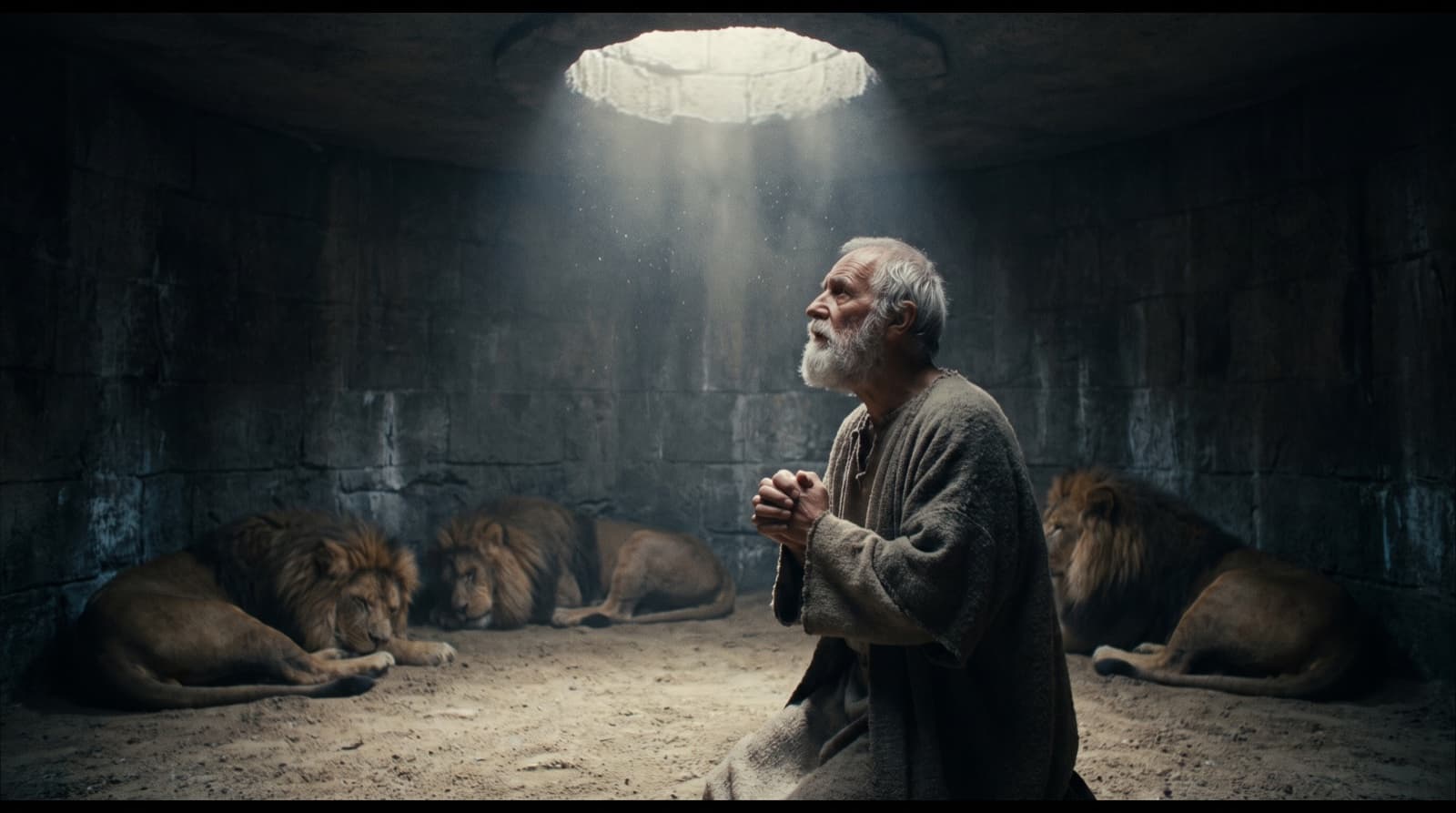
The full story of Daniel in the lions' den — the political trap, the sealed den, the angel, and what Daniel 6 is really about. Listen along.
Posted by
 HearBibleStories Editorial Team
Related reading
What Are the Ten Commandments? The Full List and What Each One Means
The Ten Commandments, listed and explained: the two tablets, Exodus 20 vs Deuteronomy 5, the numbering traditions, and Jesus' summary. Listen along.
The Good Samaritan: The Meaning of Jesus' Most Famous Parable
The parable of the Good Samaritan, explained — the lawyer's question, why a Samaritan hero was shocking, and the question Jesus flips. Listen along.
Samson and Delilah: The Full Story of Strength, Betrayal, and One Last Prayer
The full story of Samson and Delilah — the Nazirite vow, the riddle and the foxes, the betrayal for silver, and the temple of Dagon. Listen along.
By the time Daniel 6 takes place, Daniel is an old man. He was carried to Babylon as a teenager around 605 BC (Daniel 1), interpreted Nebuchadnezzar's dreams, lived through the fall of Babylon to the Persians in 539 BC, and is now serving a third empire under "Darius the Mede" (Daniel 5:31). He is likely in his eighties. The lions' den is not a youthful adventure — it is what happened to a lifelong public servant near the end of a long career.
The book of Daniel is written in two languages, Hebrew and Aramaic, and this chapter sits in the Aramaic section aimed at the wider Gentile world. It is a court tale with a sharp political edge: a foreign official so good at his job that his colleagues would rather kill him than compete with him.
A Trap Built Out of a Man's Integrity
Darius reorganizes the kingdom under 120 satraps supervised by three administrators, and "Daniel so distinguished himself . . . that the king planned to set him over the whole kingdom" (Daniel 6:3). His rivals go looking for grounds to accuse him and find nothing: he "was trustworthy and neither corrupt nor negligent" (6:4). So they reach a conclusion that is almost a backhanded compliment: "We will never find any basis for charges against this man unless it has something to do with the law of his God" (6:5).
That line reframes the whole story. The only vulnerability anywhere in Daniel's life was his devotion. To touch him at all, his enemies first had to make his faith illegal.
The Law That Could Not Be Changed
The plot is clever. The officials approach Darius as a group and propose a thirty-day decree: anyone who prays to any god or man except the king will be thrown into the lions' den (Daniel 6:7). They have it signed "in accordance with the law of the Medes and Persians, which cannot be repealed" (6:8). Persian kings were bound by their own edicts — a quirk Scripture mentions elsewhere too (Esther 1:19; 8:8). Darius traps himself with his own signature.
Daniel hears about the decree, and his response is quiet and deliberate. He goes home, and "with his windows open toward Jerusalem, three times a day he got down on his knees and prayed, just as he had done before" (Daniel 6:10). He does not protest, hide, or stage a confrontation. He keeps a habit. "Just as he had done before" is the hinge of the passage: the crisis changed nothing about his practice. This is the first of the Ten Commandments — "you shall have no other gods before me" — now carrying a death sentence.
The Night Darius Could Not Sleep
The officials catch Daniel mid-prayer, report him, and force the king's hand. Darius is "greatly distressed" and spends the day "making every effort until sundown to save him" (Daniel 6:14) — but the law is the law. Daniel is thrown in; a stone is laid over the mouth of the den and sealed with the king's signet ring and those of his nobles "so that Daniel's situation might not be changed" (6:17).
Then a striking verse: the king goes back to his palace and "spent the night without eating and without any entertainment brought to him, and he could not sleep" (Daniel 6:18). The most powerful man in the empire fasts and lies awake all night over a subordinate he failed to protect. The narrative gives Darius's anguish more room than Daniel's.
Morning at the Sealed Stone
At first light the king hurries to the den and calls out "in an anguished voice": "Daniel, servant of the living God, has your God, whom you serve continually, been able to rescue you from the lions?" (Daniel 6:20). Daniel answers: "My God sent his angel, and he shut the mouths of the lions. They have not hurt me, because I was found innocent in his sight" (6:22).
The text is careful about the reason he was spared: "no wound was found on him, because he had trusted in his God" (Daniel 6:23). The accusers are then thrown to the same lions, with their families, and the animals overpower them "before they reached the floor of the den" (6:24) — a grim confirmation that the den was fully lethal and the rescue fully miraculous. Darius issues a new decree ordering reverence for "the God of Daniel," "the living God, enduring forever" (6:26).
Not a Rescue Story — a Faithfulness Story
It is tempting to read Daniel 6 as a promise that faith keeps you out of danger. The book itself resists that. A few chapters earlier, Daniel's three friends face a furnace and tell the king that God is able to save them, "but even if he does not," they still will not bow (Daniel 3:17-18). Hebrews 11 praises people who "shut the mouths of lions" (11:33) in the same breath as people who "were sawn in two" (11:37). Rescue is real, and it is not guaranteed.
What the story holds up for imitation is not the outcome but the pattern: an unbroken habit of devotion that a change in the law could not interrupt, kept without drama by a man who had nothing to hide. Read this way, the den is less about lions than about what a person does in the ordinary hours before the crisis arrives. Daniel's courage in Daniel 6 is really the visible edge of decades of unremarkable mornings at an open window.
It is the same quiet consistency Jesus points to in the parable of the Good Samaritan, and the opposite of the pattern in the life of Samson, whose gift was enormous and whose discipline collapsed. Daniel and the lions is one of the most vivid scenes in the Old Testament, and it lands differently when you hear it read from the palace to the den in one sitting. You can listen to the story on HearBibleStories and follow the whole trap as it closes and springs open again.
Listen to these stories
Daniel in the Lions' Den
His enemies made prayer illegal. He opened his window and prayed anyway.
Daniel 6:1-28
The Fiery Furnace
The king threw three men into the fire. He saw four walking around inside it.
Daniel 3:1-30
Daniel's Training
They tried to make him Babylonian. He stayed faithful at the dinner table.
Daniel 1:1-21
Hear the Bible come to life
Listen to hundreds of Bible stories with HD narration on the HearBibleStories app.


Or browse the full story catalogue on the web.
Related reading
What Are the Ten Commandments? The Full List and What Each One Means
The Ten Commandments, listed and explained: the two tablets, Exodus 20 vs Deuteronomy 5, the numbering traditions, and Jesus' summary. Listen along.
The Good Samaritan: The Meaning of Jesus' Most Famous Parable
The parable of the Good Samaritan, explained — the lawyer's question, why a Samaritan hero was shocking, and the question Jesus flips. Listen along.
Samson and Delilah: The Full Story of Strength, Betrayal, and One Last Prayer
The full story of Samson and Delilah — the Nazirite vow, the riddle and the foxes, the betrayal for silver, and the temple of Dagon. Listen along.
What Made David a Man After God's Own Heart?
David committed adultery and murder — so why does God call him a man after His own heart? Discover the honest, layered answer. Listen on HearBibleStories.