Why Were Sodom and Gomorrah Destroyed? What Genesis Actually Says
Genesis 18–19 on why God destroyed Sodom and Gomorrah — Abraham's bargain, the sin of the city, and Lot's wife. Listen to the story on HearBibleStories.
Posted by
 HearBibleStories Editorial Team
Related reading
Why Did God Flood the Earth? The Real Reason Behind Noah’s Story
Discover why God sent the great flood in Noah’s time. Explore Genesis 6, the violence that filled the earth, and the hope found in the rainbow covenant.
Why Did God Test Abraham? The Three Layers of Genesis 22
Why did God ask Abraham to sacrifice Isaac? Unpack the three layers of Genesis 22 — and why this story points straight to Jesus. Listen on HearBibleStories.
What Are the Ten Commandments? The Full List and What Each One Means
The Ten Commandments, listed and explained: the two tablets, Exodus 20 vs Deuteronomy 5, the numbering traditions, and Jesus' summary. Listen along.
The destruction of Sodom and Gomorrah is one of the most referenced events in the Bible — Jesus mentions it, so do Peter, Jude, and the prophets — and one of the most misremembered. Genesis 18 and 19 tell it carefully, and the details matter.
The Outcry That Reached God
Genesis 18:20 sets it up: "The outcry against Sodom and Gomorrah is great and their sin is very grave." The Hebrew word for "outcry" (tse'aqah) is the same word used for the cry of the oppressed — the groan of Israel under slavery in Egypt (Exodus 3:7), the cry of a robbery victim (Deuteronomy 22:27). It is not the sound of a city enjoying itself. It is the sound of people being harmed by it.
God says he will "go down to see" whether the outcry matches the reality (Genesis 18:21). The language is deliberate: judgment here is investigated, not impulsive.
Abraham's Bargain
What follows is one of the boldest conversations in Scripture. Abraham stands before God and negotiates: "Will you indeed sweep away the righteous with the wicked?" (Genesis 18:23). Will you spare the city for fifty righteous people? Forty-five? Thirty? Twenty? Ten? Each time God agrees.
Abraham stops at ten. The narrative never says why — but the implication is stark. There were not ten. The nearest thing to a righteous household was Lot's, and as chapter 19 shows, even that was compromised. This is the same Abraham whose trust God would later test on Mount Moriah, in the near-sacrifice of Isaac; here his instinct is to plead for mercy on strangers.
What the Sin of Sodom Actually Was
Genesis 19 shows two angels arriving in Sodom at evening. Lot insists they stay with him rather than sleep in the square — he knows what the square is like after dark. That night "the men of the city, the men of Sodom, both young and old, all the people to the last man," surround the house and demand Lot hand over his guests to be raped (Genesis 19:4–5).
The text is describing a mob, not a private life: every man in the city, attempting gang violence against travelers under the protection of hospitality. That is the concrete crime the narrative puts on the page.
The rest of the Bible fills in the pattern behind it. Ezekiel 16:49 is the most explicit summary: "This was the guilt of your sister Sodom: she and her daughters had pride, excess of food, and prosperous ease, but did not aid the poor and needy." Isaiah 1:10–17 addresses Jerusalem as "Sodom" and defines the charge as injustice — bloody hands, oppressed widows, ignored orphans. Jesus links Sodom to towns that refuse hospitality to his messengers (Matthew 10:14–15). A prosperous city that used its comfort as a license to abuse the vulnerable — that is the biblical profile.
Lot's Wife
The angels drag Lot, his wife, and two daughters out by the hand "the LORD being merciful to him" (Genesis 19:16) — the rescue is almost forced. The instruction is simple: flee to the hills, do not look back, do not stop.
"But Lot's wife, behind him, looked back, and she became a pillar of salt" (Genesis 19:26). The southern end of the Dead Sea is ringed with salt formations, and travelers for centuries have been shown one and told it was her. Jesus turns her into a two-word sermon: "Remember Lot's wife" (Luke 17:32) — a warning against being rescued in body while your heart stays with what is being left behind.
Fire, Sulfur, and What Was Left
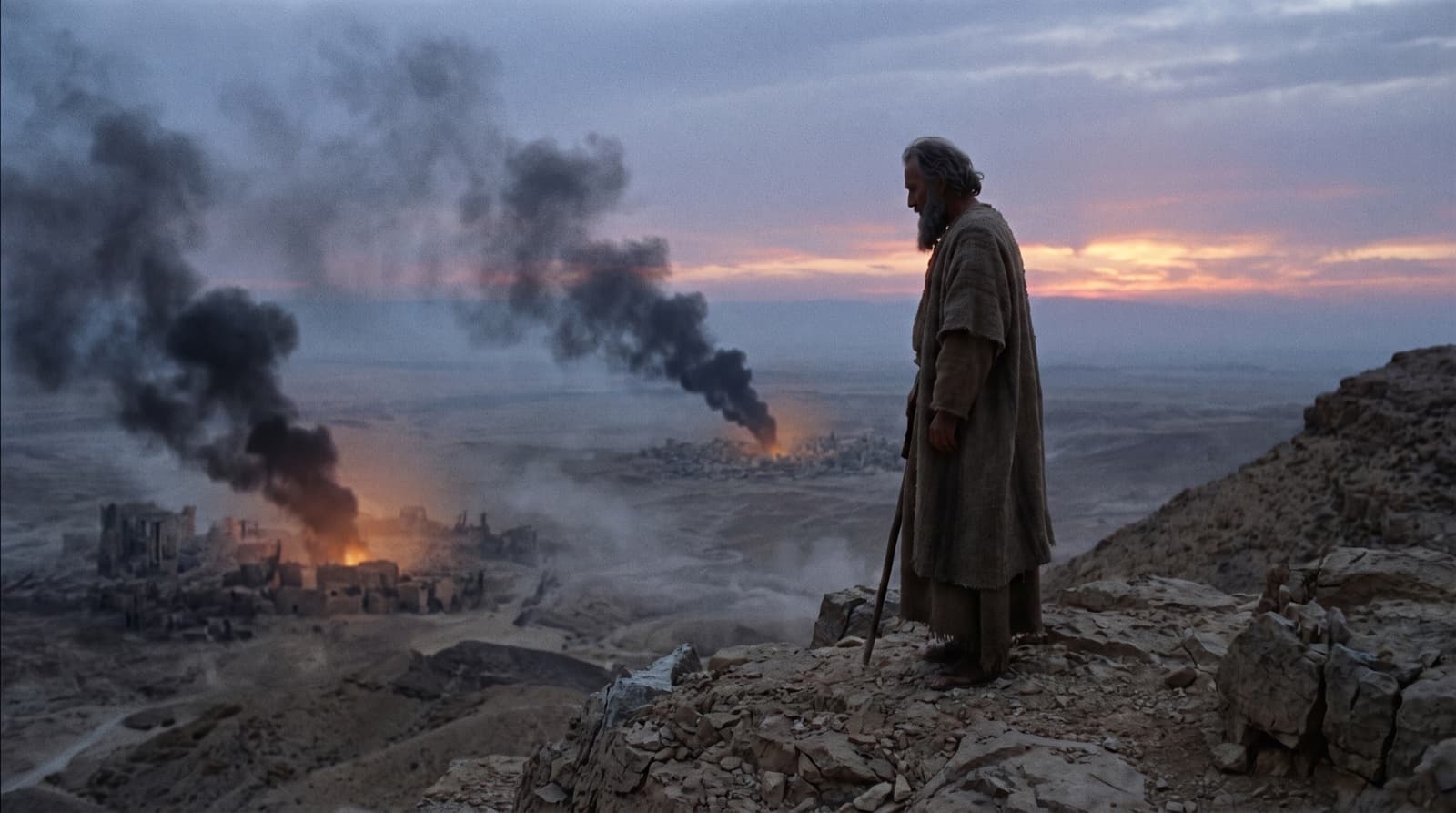
Genesis 19:24–25 describes "sulfur and fire from the LORD out of heaven" overthrowing the cities and the whole valley. The region at the south of the Dead Sea is rich in bitumen, sulfur, and natural gas — Genesis 14:10 already noted its "bitumen pits." Whatever the mechanism, the narrative frames it as direct judgment, and the site became a permanent object lesson: Deuteronomy 29:23 calls the land "brimstone and salt, a burnt-out waste."
One detail is easy to miss. Genesis 19:29 says God "remembered Abraham, and sent Lot out of the midst of the overthrow." Lot is saved not on his own merit but because Abraham interceded. The bargain in chapter 18 was answered after all — just not in the way Abraham asked.
Why It Still Gets Cited
Sodom became the Bible's shorthand for a society ripe for judgment — not primarily because of any single vice, but because of the whole shape of a place that had everything and used it against the people with nothing. The prophets throw the name at Israel. Jesus throws it at religious towns that reject mercy. The pattern outlives the city.
It reads very differently when you hear it as one continuous scene — Abraham pleading on the ridge, the angels at the door, the family stumbling out at dawn. You can listen to the story on HearBibleStories, and hear it beside the flood in Noah's day, the other great judgment-and-mercy story of Genesis.
Listen to these stories
Sodom and Gomorrah
Abraham bargained with God — and God let him.
Genesis 18:16–19:29
Abraham and Lot
Sometimes the generous choice and the wise choice are the same thing.
Genesis 13:1-18
Abraham Sacrifices Isaac
God asked for the one thing that would cost Abraham everything.
Genesis 22:1-19
Hear the Bible come to life
Listen to hundreds of Bible stories with HD narration on the HearBibleStories app.


Or browse the full story catalogue on the web.
Related reading
Why Did God Flood the Earth? The Real Reason Behind Noah’s Story
Discover why God sent the great flood in Noah’s time. Explore Genesis 6, the violence that filled the earth, and the hope found in the rainbow covenant.
Why Did God Test Abraham? The Three Layers of Genesis 22
Why did God ask Abraham to sacrifice Isaac? Unpack the three layers of Genesis 22 — and why this story points straight to Jesus. Listen on HearBibleStories.
What Are the Ten Commandments? The Full List and What Each One Means
The Ten Commandments, listed and explained: the two tablets, Exodus 20 vs Deuteronomy 5, the numbering traditions, and Jesus' summary. Listen along.
Why Did Moses Not Enter the Promised Land?
Moses led Israel for 40 years but never entered Canaan. Discover the one moment in Numbers 20 that cost him everything — and what it means for us today. Listen now.